

…Part two in a three-part series, continuing from The Monkey Puzzle, the following explores lessons learned from remote teaching/learning experiences during a global pandemic.
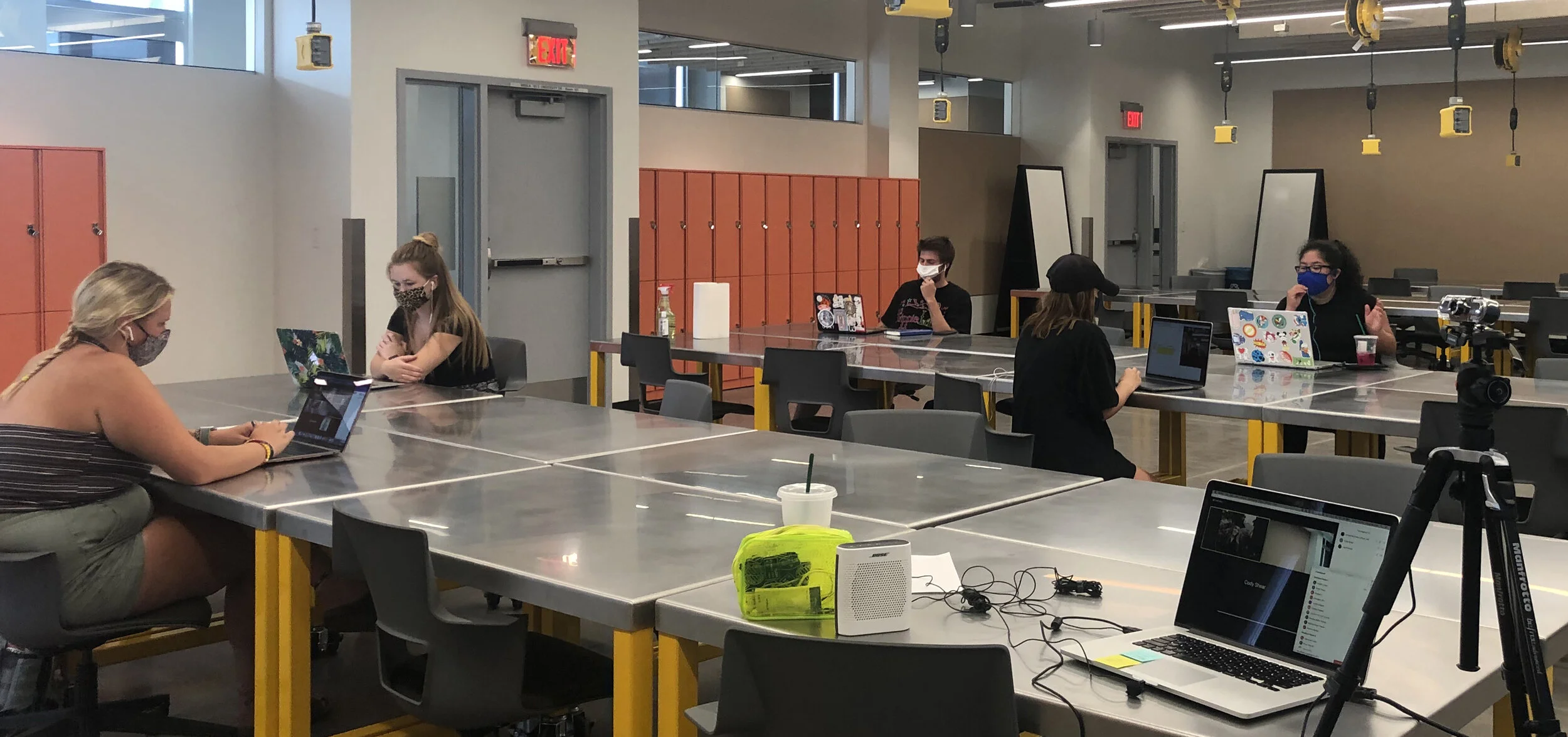
design school students attending class in-person while most of their classmates attend via Zoom at Arizona State University, fall 2020
ONCE A NEW IDEA SPRINGS INTO EXISTENCE IT CANNOT BE UNTHOUGHT. —Edward de Bono
In a speech to the Arizona Board of Regents in May of 2020, Arizona State University President Michael Crow made a point that shifted how the board and the university saw learning moving forward. He noted, as he listed out the various supplies needed to implement our version of blended leaning in the age of COVID—millions of gallons of hand sanitizer, thousands of remote teaching technological tools, and fundamental classroom structural changes—that we need to recognize while the pandemic will eventually subside, its impact on education would not.
He noted “we do not need to weather the storm. We are not in a storm. We’re in a new environment.” And he’s right.
Teaching as it has always been? Classes held fully in person or entirely online? Those modalities are shifting. The structural divide between online and onsite learning no longer exists.
This means we have some work to do to overcome known issues such as rejection by Gen Z audiences and and a perceived lack of human connectivity found within preconceptions surrounding online learning. So let’s consider these issues—let’s look back a few months and figure out what happened.
A PROBLEM WELL-STATED IS HALF SOLVED. —John Dewey
One reason current generations may be rejecting the idea of online learning may have something to do with their introduction to it. As universities moved quickly to remote formats to protect the health of students and faculty, the intention was just to make it to summer. Once summer hit, everything would calm down. Return to normal.
And then it didn’t. It got worse. And as we watched COVID numbers increase and civil unrest erupt around us, universities had to rethink the fall semester entirely, and we again approached the problem with band-aids rather than restructuring it to lean into its strengths.
While we may have done a number of things wrong in moving students online, online education itself does a number of things right. It makes it easier—and less expensive—to bring in guest speakers from around the globe.
And it makes it easier to build a global network of academic and professional partners to augment and expand curriculum. For example, one of our current masters programs is working with students and professionals across the country on various real-world projects, building new ventures and meeting with leaders of industry—something that would have been far more challenging to implement in person (though we had ideas).
Online education also lets us recruit faculty from around the world without worrying about what will happen when they reach customs. Currently, The Design School has no fewer than ten of our 65 faculty working outside of Tempe, across the US and abroad. And many of our part time faculty also live and work outside of the Phoenix area. This lets us work with a wider range of experts, bringing new thinking to our students from around the globe.
But online education does more than bring opportunities for remote collaborations.
We see the struggle of students faster than we would in a classroom. Exhausted faces staring back via zoom give a clear indication of how things are going. Missing weekly check-ins or turning it work consistently late become large red flags that are easier to spot in a virtual environment. So we can reach out faster and help, meeting students 1:1 via zoom to help answer a homework problem, or setting up meetings with them to discuss options when things are not going their way.
Beyond this, the pre-built nature of the online class frees the faculty to engage with the students more in the class environment. Pre-recorded lectures and reading materials flip classrooms easily, leaving any class meeting time open to discussion, expansion, tangents, and outtakes.
In reality, online education is an amazing tool. But, like the students, the faculty still want that 1:1 interaction that can only come with a synchronous system. So we’re investigating how to apply that within our online programs currently under construction, building them using blended formats rather than simple synchronous and asynchronous systems. So far, it’s holding promise.
And this is where online is heading. This is the fundamental change ASU’s President Crow was remarking on in his board of regents address. This is our new environment.
What an incredibly exciting brave new world.
…more to come…